Sunday, April 12, 2015

A letter to my favorite volunteers.

Today begins the week we celebrate our volunteers in the United States. While there are plenty of volunteers that I work with between many organizations, I really just wanted to lift up some of my favorite volunteers.


Mom and Dad,

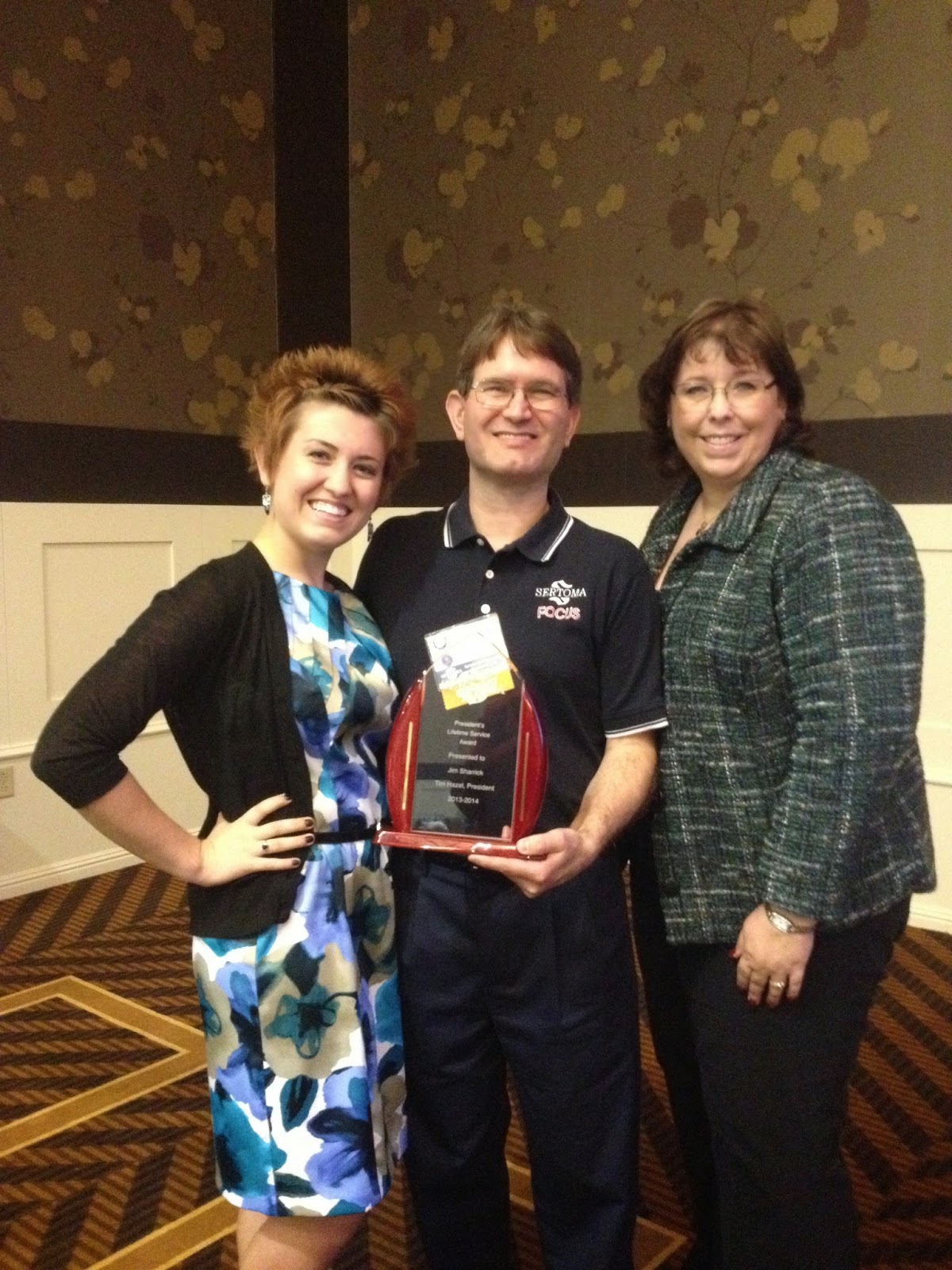
Dad's Lifetime Service Award
last spring for SERTOMA
You both have taught me so many valuable things in life (there's always room for ice cream because it melts around the edges of all of the other food in your stomach/shoes are beautiful...buy all of them--yes, Mom, you can make fun of me all you want, but I know I got my shoe obsession from you), but the imperative to volunteer and to be part of the community is one of the most important things you have taught me. You have practically engrained it in my DNA since the very beginning. Heck, my very first service organization (Sertoma) meeting was when I was just days old.

Your volunteering has taken different forms over the years and the list of organizations you've been part of (and individuals you have assisted) is too long for this post---not to mention the fact that I don't even know the comprehensive list. You were never flashy and boastful about it, but I want you to know that I've been watching and learning from your example.

Thank you for modeling great leadership skills and working to teach others the same. Thank you for teaching me to be part of the community. Thank you for cultivating the belief that I should give and not expect anything in return. 

Some of my favorite memories are handing out chips and cookies to the football players at the 8 Man Sertoma All-Star Football BBQs and all of the trips to Regional and Int'l Conventions to see Tim, Pat, Eunice, Dale, Tom, Sheila, Paula, Brownie, and the rest of the gang (I also have fond memories of going to see Mickey while you went to boring meetings!). Memories of playing hide and seek in a dark church and learning where all the Sunday school teachers kept snack jars I could eat out of while Mom was in choir--okay, so maybe I didn't learn only good things while you volunteered....

My life would be vastly different, and much less rich, without volunteer experiences. I know that I would not be where I am now and would not be doing the exciting things that I get to do without the example you have set for me.

So this week, and every week, I celebrate all that you have taught and modeled for me.

Thanks and love you forever and always,
Jen-Ben

Thursday, April 2, 2015

State Board of Education

If you know me at all, chances are you know that I'm a big supporter of comprehensive sexuality education (CSE). What exactly is CSE, you ask? From some supporting materials I got at the UN from the CSE programs in Germany and France…
"CSE should be based on a holistic concept of well-being, that includes sexual health. It should address all aspects of sexuality, including pleasure, as well as social norms and gender roles. It should be firmly rooted in self-determination, gender equality and the acceptance of diversity, free from judgement and stigmatization. It should be mandatory, starting in early childhood, and be provided in accordance with the evolving capacities of young people. Finally, CSE should deliver scientifically-accurate information on sexual health and rights, including on contraception, abortion and STIs. 
CSE should aim at empowering young people so that they acquire the means and skills to fulfill and advocate for their rights, to live and express the sexuality freely, to develop critical-thinking and to exercise full citizenship and autonomy in all aspects of their life. It should be understood as a way to create a safe and respectful environment, preventing discrimination and violence based on gender and/or sexual orientation." (emphasis my own)
So I pretty much think it's the bees knees. It goes so much further than just talking about sex or about how abstinence is the only way until marriage and goes into relationship negation and many other things (more on that later).

Well anyway, the Nebraska Board of Education had a work session meeting today discussing a grant that the Department of Education received that is doing some CSE work (nothing has actually been done about teaching students about sex at all…it's been about LGTB inclusiveness, bullying, learning about your own school's policies about sex ed or creating one, involving community partners, etc).

And I went to go give public comment in support of CSE. Here's what I said (minus a few things that I ad-libbed that I don't remember…) :
Hello my name is Jenny Sharrick and I am a public health student at UNMC. Thank you to the board for this time to speak.

Just last month I attended the UN Commission on the Status of Women in New York City. This year's commission was a 20 year review of the Beijing Platform for Action. We have made a lot of progress in the past 20 years to achieve gender equality and gender equity globally. But there are still many things to be achieved for the improvement of women and girls' lives; specifically the U.S. struggles with sexual assault and gender based violence. This fact was emphasized and re-emphasized at the meeting.

Returning to my life in Nebraska, I have done CSE for almost a decade now. In that time, it has taken many forms but for now I spend lots of time in the Douglas County Youth Correctional Facility and Omaha Home for the Boys transitional living home doing CSE. At the Youth Facility, too many of the detainees are there because of sexual assault or gender-based violence. Over 90% of them are sexually active; many even have children. These are not adults, these detainees are aged 8-18. The youth at OHB are very similar in their experiences moving through the foster care system in Nebraska. Just this week I had a conversation with a 19 year old at Omaha Home for the Boys who was worried about taking a paternity test for a child with his ex-girlfriend. He's not ready to be a father because he understands the weight of that, but no one talked to him before they were sexually active about what the possible ramifications of unprotected sex could be. These youth are eager to learn about their own health and how CSE affects their lives. These youth are no different than any of the other youth in Nebraska.

CSE is so much more than talking about dichotomous ideas of being sexually active or not, using contraception/protection or not, being abstinent or not. CSE IS about partner negotiation, what is and what isn't consent, what qualifies as good touch and what is bad touch, goal setting for your own life, and knowing your own body and your limits. Most of these things don't even have to apply to sexual health, but rather are important in overall health and well-being. But ALL of these things need to be discussed in a safe space to heave healthy relationships before the real life situation arises.

These topics are essential to youth growth and development. They are also in line with the Millennium Development Goals, the upcoming Sustainable Development Goals & the Beijing Platform for Action, which are frameworks that guide us globally. Nebraska is working to be in-line with these aforementioned goals because of the WISE method and the funding from the Grove Foundation. Continuing these programs is imperative for the youth of the state. And hopefully, as a secondary benefit, we can also affect the state's teen pregnancy and STD transmission rates and reduce sexual violence in Nebraska. But first and foremost, we empower our students and youth to make the best health behavior decisions they can. 
 
I just thought I would share. In the 5 minutes I spoke, I couldn't touch on all of the points about CSE that I think are so beneficial, but those were some that people often don't think about. It was an awesome experience and fun to network with some of the organizations in Omaha that are also doing amazing work in this area.

Monday, March 30, 2015

Fairy Godmother Tales


To start off my spring break this year (just over a week ago), I headed to South Dakota to visit my godchildren. They are (almost) 7 and 4 years of age. The eldest, "D", has called me her fairy
godmother since she was very little and has shared in my love of glitter and all things shiny, much to her father's dismay--sorry, I'm not sorry Mike! :) She was the very first to announce that my favorite color was "glitter" when she was maybe 3-4 years old, even though it really is silver. The younger, "J", is your typical 4-year-old boy...far more interested in catching bugs than learning his letters, shapes, and numbers. He's one of the busiest boys I know who will someday become a storyteller of some sort for his profession.
Maybe I could have a better outfit too...?

Just thought I'd share some funny tales from my quick trip!

J: "My old friend the clam hugged me and that's how I know so much about shells."
(pauses for dramatic effect)
J: "But he washed away to make new friends."
***I also learned about his "old friend" the owl and several other old friends that are also animals. I'm convinced in another life that J was actually an old man in the South who sat in a rocking chair on his front stoop/in front of the town grocery store/cafe and just shot the breeze all day telling stories of his good ole days. The kids has some serious tales....***

D: (telling me about the tooth fairy coming a few weeks ago) "She brought me $15. She has long red hair like me, but long like Rapunzel. She's also little."---for the record, I am confident that she didn't bring $15, but that fairy still pays much better than my tooth fairy did!

J: "I'm not ornery. I give myself good ideas."

Me: "I'm tired. You wore me out today."
D: "It's what kids do!"
(adults all chuckle)
D: "Well it is..." (in an exasperated [almost] 7-year-old voice)

To top off the whole weekend, we went to watch Cinderella in theaters. Talk about fairy godmother! I don't know that I will be able to magically provide a pumpkin carriage to the ball for either of those two, but maybe our fun art projects, cooking, and playing together along the way will make up for my lack of fairytale magic. I'm so happy I was able to spend some time with them last weekend! 

Tuesday, March 24, 2015

Hooray, I'm a guest blogger!

I guest blogged today. Well actually I guest blogged last week, but I finally got the courage to post it today. Or did I really guest blog when it was a requirement of being part of the cohort that went to the UN Status on the Commission of Women? I don't know. Point is, I have blogged! You can find it here. Or you can just read it below. [Side note: it was really weird for me blogging under a different domain...I felt like I had to watch what I wrote more than I do here because it was for a different audience or something. Definitely a good experience though.]


Breaking the silence. Dismantling the stigma. Erasing the shame.


(Trigger Warning: This post discusses sexual assault)
When preparing to come to the Commission on the Status of Women (CSW), I thought I knew what I’d hear about. I’m currently a public health student in the area of maternal and child health so I spend my days considering social determinants of health such as poverty, access to food and healthcare, educational attainment, local laws pertaining to women and their enforcement (or lack thereof), gender-based violence such as sexual assault and domestic violence, and the unique health disparities of women in conflict zones.
In all of these areas, and more, women and girls face inequalities when it comes to health. They do not have the rights or access to make decisions about their own bodies in many cultures. They are disproportionately affected by hunger and poverty. In some places they still cannot own land or make financial decisions. In far more places than I care to think about, women and girls are used in war situations as objects for gaining power.
I knew I would hear reiterations of the same ideas while at CSW. What I did not realize was how focused this year’s events would be on the violence and sexual assault that women and girls face all over the world on a daily basis.
In my other life at home, I do a lot of work in my community with sexuality education and sexual reproductive health. That has taken different forms over the past decade, but right now it’s predominantly concerned with the epidemic rates of both chlamydia and gonorrhea in Douglas County, Nebraska, where I currently live. Along with many other community partners, our primary focus is within the incarcerated population because they experience many forms of health disparities before, during, and after incarceration. 
no does not mean convince meThat means that I spend my time in and out of the youth correctional facility (ages 8-18) and the adult jail (age 18+) doing age-appropriate, evidence-based, medically-accurate presentations about sexually transmitted diseases (STDs), sexual assault and consent, and STD transmission and prevention methods.
We already have conversations with the youth detainees about consent, but as I was very poignantly reminded at CSW that 1 in 4 women will be sexually assaulted by the age 18 and 1 in 3 in her lifetime. This is not including the 1 in 6 males (or likely more due to underreporting) who experience sexual violence before the age of 18 in the United States.
The conversations I’m having are clearly not enough.
Now, don’t get me wrong. I definitely do no think that all persons detained are rapists or have sexually assaulted someone. Similarly, I know for a fact that every person who has sexually assaulted a person is not detained.
But I do know that I can do something to further the conversation surrounding consent. Even if within my own tiny sphere. I don’t know explicitly how to alter the curriculum we are using, but I now head back to the literature to figure out what has worked in other communities. And I will also expand these conversations to the adult inmate population–we know that we are never too old to learn something new.
While the work that I do is not directly linked to a church or congregation, it is linked to my faith and concern for justice. That does not mean that the Church cannot be a leader in impacting the problem. In fact, I wish there were more congregations that were explicitly addressing these concerns. There are greater conversations about what is “good” touch and what is “bad” touch, good/bad relationships, partner negotiation, and what qualifies as consent (and also what doesn’t qualify as consent) that the people in your pews are aching to hear…they just may not express it for fear of the silence, stigma, and shame surrounding the topic.
I challenge you now, Church, to be the voice for good. Preach and teach on those texts in the Bible dealing with violence (yes, they are in there). Discuss those feelings, insecurities, and fears…be sure to get at the root causes. But most of all, I challenge you to be a safe space and provide healing for those who are victims of violence of any kind.
Let’s break the silence, dismantle the stigma, and erase the shame.
Jenny Sharrick, Omaha, Nebraska


Monday, March 16, 2015

UN Commission on the Status of Women

[Once I kick this sinus infection (it's going to happen...even if I have to sleep for the next gazillion hours and bathe in antibiotics...it WILL happen), I will post summaries of all of the sessions I went to. For now, I leave you this...]

The group that headed to NYC last week to the UN has their own blog. YOU can read it. The people that I spent my week with are amazing. They truly are. I am humbled to be in their presence and to learn from and reflect with them. Our reflections from while we were there and some from after the experience are/will be posted there. If you're interested in what millennials have to say about being part of the Church and being involved with justice work, you WANT to read this stuff. It's so rich and awesome!

If you want to see a pictorial and social media update of the things that happened, look at our Storify. You'll get quotations from sessions we were in and pictures of the things we were involved with. Plus a more spread out point of view than if you just read my blog!

But more to come...so much left to process though. And naps to be had first :)

Wednesday, March 4, 2015

#ELCAWH15

Hope Evangelical (one of our hosts)
In January I went to San Francisco for a gathering of ELCA World Hunger leaders (yeah…a little slow on the blogging about it, but what else is new this year?). This meeting happens every 18 months at various locations throughout the country. As soon as I heard where it would be, I was SUPER excited to go…Nebraska in the winter is usually terrible. Unfortunately for me, the weather in Nebraska was actually pretty warm the weekend I missed. Oh well, I survived anyway!

Sanctuary at Hope Evangelical
In addition to the normal meeting that they usually have, this meeting also included the other young adults that are in the young adult cohort. This group of people is the group that is going to the United Nations Commission on the Status of Women later this week. Some of the group also goes/will go to the International AIDS Conference every two years.


If you'd rather see how the conference went instead of reading my babble about it, find our storify page. Storify is a super cool tool if you're running a meeting/gathering/conference/super awesome super bowl party where you can pull in social media posts using your hashtag (#ELCAWH15 in this case), to see a visual representation of the event. There will be a storify for my trip to NYC later this week too that you can check up on!
Ministry Fair! This was the setup for "Bountiful Harvest"
--a food co-op in Omaha out of First Lutheran
Bird of Paradise
(my favorite flower!)
The theme of the event was "Congregations for Change: We are Church Together". There were large group sessions, small group training sessions, a ministry fair (showing the cool projects that people around the US were doing to combat hunger), and, of course, plenty of worship experiences sprinkled throughout. 

Two of the coolest experiences of the weekend were the neighborhood walks and the small group time we had as a young adult cohort. I will probably talk plenty about the young adult cohort in the coming weeks, so I'll skip that for now.

Neighborhood Walk art
The neighborhood walks were very interesting. The idea behind the walks was that we are so familiar with the things in our own neighborhoods that we hardly ever take time to truly see them for what they are. We don't see the shortfalls because we are think we are familiar with the area...but we actually become blinded. But even more so, we don't see the potential for changing those shortfalls. We need new eyes to assess the area and its assets.


Walked through part of Oakland
to meet-up wit part of the group
With issues of hunger specifically, we think "Oh there are people that are hungry in big cities/Africa/developing countries," but we aren't so great at identifying hunger in our own areas. This was a dedicated time to discover hunger in our "own" area. Definitely a cool idea and provided lots of time for reflection.

We split into groups and toured different churches/ministries in the San Fran/Oakland area based on our interests. I chose to tour "Night Ministry" which is out of St. Mark's ELCA. It's a 50-year-old collaborative ministry for those who are homeless or out for a night-on-the-town in the Tenderloin (and thereabouts) district in San Francisco.

There are two parts to the ministry: 1) Night Ministers that walk the area each night from 10 pm - 4 am, 2) crisis intervention help-line counselors that answer phones on the crisis line each night during the same time period. Additionally, they have a weekly outdoor worship service for anyone that wants to come. They have not missed a single night shift in the 50 years they've been in operation. 

"Remember Them"
Sculptures of several humanitarians
"Remember Them"
"Remember Them"

Miracles of Faith Church
We had a sack lunch and impromptu
(and passionate) worship service here.
The pastor I followed (there are 6 or so on call every night) was ordained in the UCC and also leads worship for an ELCA congregation and weekly prayer with some Franciscan nuns. He was well known by the men and women who lived in the area. We heard from other groups that many people were asking for him as well. The ministry has truly been a ministry of presence in the area. Sometimes the only thing a person needs is someone to listen. Some of the people we met shared their stories about what happened in their lives to lead to homelessness, some just said hello. Regardless, encountering people was amazing.

by-the-cup brewed coffee
nom.
Besides the neighborhood walks, we also had some training sessions on advocacy, fundraising, sustainable development goals, networking, and others. We also used some of the resources that the ELCA puts out about hunger education. A very well-rounded conference to touch on each of the tenets of ELCA World Hunger: Relief, Education, Advocacy, Sustainable Development, Organizing, and Networking.
made-to-order ice cream sandwich at the amazing #CreamNation
The best thing I've ever had (maybe).

St. Mark's (another host)
On the final day, the Young Adult cohort and some ELCA staff members took part in the MLK Day march. Whoa. That was super powerful. I've never been part of a political march like that...the closest thing I've come to is the Take Steps Walk for Crohn's and Colitis or the AIDS Walk every year. But this was far better attended than either of those walks. I'll just let the pictures speak for themselves.

MLK Day march 
We are hungry for justice. 
You can see the line curving to the left across the bridge.

Cohort @ MLK Day march
MLK Day march


MLK Day march

Ecumenical worship at the end of MLK Day march


Thursday, February 26, 2015

You know you're official a public health nerd when...

...you get the "Kids Count 2014 Report" in the mail (data on kids throughout the state of NE broken down into county, race, gender, etc.) and you are so stoked!!!! I mean just look at these beautiful pages...

% children 17 & under in poverty
1 in 8 NE households experience food insecurity


In other news:
  • Speaking of school, had 4 papers and a short presentation due this week, so I'm very sorry that I haven't update the blog more this week. I'm also trying to get all of my homework done before I leave for the UN CSW over the next two weeks, but I will try to get another big one out tomorrow sometime about my time in San Francisco. 
  • Started my new job today. I work with infants! Babies e'reday of the week. It's great. It is a really fun atmosphere and I think I will fit in very well there.
  • There's a fan club for me! Okay, it's really not for me. It's actually for a plane named Jenny (which I have a t-shirt of, btdubs). I just like to think that I'm famous. 

Tuesday, February 17, 2015

Catching Up

It's been over a month since I've posted anything on the blog. And over two months since I posted any of my own original content. Yeesh. That's embarrassing. I thought I would get my act together over the holidays when I wasn't so stressed about final exams and projects, but clearly that hasn't happened.

I have been quite busy over the past few months with school and work. The daycare kiddos have been hilarious, endearing, challenging, and everywhere in-between in that time (and always a cesspool of germs, as my good friend Meredith likes to say). Thursday of this week will by my last day at the YMCA Child Development Center and next week I will start at a faith-based daycare that I hope is a little more matched to my life's philosophies.

Last semester my big school projects focused on HPV vaccination attitudes and why young people do/don't get the vaccines series and about pre-/interconception care and its benefits (reproductive life plans people...everyone needs 'em!....Do you want kids? How many? How far spaced apart? If you don't want kids now/ever what are you doing to prevent conceiving? How is your general health? What is your current weight? Etc). This semester my big projects are mostly focused around rural hunger (we know quite a bit about what hunger/food insecurity "looks" like in urban areas, but much less about hunger/food insecurity in rural areas...such as most of Nebraska!). I have also been doing LOTS of learning and preparing for my trip to the UN's Commission on the Status of Women in two weeks!! Plenty more on that later. It's coming up so quickly and is so exciting and overwhelming. I really should journal or something because I'm an emotional roller coaster all day, e'reday about it right now.

Okay, now to things that I wanted to devote a whole blog to, but just don't have the time to anymore. These things were all the way back in...November. Nothing like a 3 months lag on blogpost writing (yikes). I was involved with both the First Lutheran's Hunger Conference and the Society for the Scientific Study of Sexuality (SSSS) conference...on the same weekend...in Omaha. Talk about switching gears! I legitimately would finish with one conference drive a few blocks and walk into the next one. Although tiring, they were so much fun!

Starting with SSSS. I, along with several others, presented a poster about challenges we experienced when moving our STI education/testing program from the adult jail to the youth detention facility. It was well-received by the other attendees at the conference (not to brag...but totally bragging! We are a very special organization that does this sort of work with an incarcerated population...they are often underserved in many areas of healthcare and I'm proud to be working with an organization trying to lift up that need). I went to several oral presentations about different topics having to do with sexuality education and research. Some of the more interesting ones had to do with social media and how that is affecting the mental health of LGTBQIA persons (the Grindr effect: 1) "rejection protection" because the photo of the person you are scrolling past seems to be further/more disconnected from you...the rejection is never in person, 2) "kid in the candy store" phenomenon where there is a perception of an unlimited number of potential partners, 3) "shopping effect"..what's next? who will be better?, 4) "X-ing out/social blocking" where younger persons are having difficulty entering and leaving conversations in real-life because on the internet you can just "X" out of a conversation window without needing to know how to end a conversation formally, 5) "social scrolling" where people have low accountability and inauthenticity due to anonymity). Those were some very interesting considerations I would have never taken into account about how social media affects us. I also went to a very interesting discussion about gender creative children and the process of getting them into medical treatment if desired for transition. It was an extremely informative conference and lots of fun!

At the First Lutheran hunger conference, the conversation centered quite a bit about "helping, not hurting" with our efforts to reduce food insecurity and hunger in the US specifically. Dan Rift, the Director of ELCA's World Hunger and Disaster Response, rightly said that "Jesus was a foodie." While that got several chuckles (from those of us young enough to identify with what a "foodie" is), it hits the nail on the head. Jesus did directly confront bankers, churches, and politicians about why they were keeping the poor and hungry, poor and hungry. The conversation continued to some of the work that the ELCA does globally. And in some ways we do a heck of a lot better of a job internationally with hunger than we do here. Do you know why? Because globally we actually ask those that we are trying to "help" what it is they need. In the US we have this tendency to assume what people that are hungry need...it's food, right? (Not always...sometimes food, shelter, health insurance, etc can come first too). The following morning our keynote speaker was Robert Lupton, author of Toxic Charity. Although I'm not sure I can agree 100% with all of his conclusions, it's a good, quick read for anyone interested. Lupton's thesis basically works around looking at our unexamined practices of giving to charity in this nation. Instead of evaluating the charity outcomes by how many people were fed/clothed this month by this charity, look at the downstream effects, "Are the poor becoming less poor because of what we are doing?" His most impressive solution to the question he's asking is the FCS Urban Ministries in Atlanta. Basically they revitalize neglected neighborhoods by doing a community needs assessment and finding areas of health to restore. They do this by using the core values of dignity, empowering and neighboring. He has found that mixed income housing areas really work and provide natural avenues for leadership and lifting poverty-stricken areas out of poverty. It's an interesting theory for sure. There was lots of push-back of his ideas so the conversations continued there. The thoughts still run through my head very frequently...I try to be a responsible giver when I can instead of just throwing money at an issue without knowing if what I'm throwing money at is even something that can be effected by money being thrown.

Well that's probably enough for one post. I have a few more posts planned, but for now I've at least caught up from the happenings of 2014. No promises about when I will finally get back with the next post though :)
Tuesday, January 6, 2015

Guest Blogger: Part 3

I'm starting the new year off with a guest blogger...mostly because I have been busy galavanting around between Hastings and Omaha and I just never seem to have the time to sit down and write. I'm hoping to get a post or two (of my own) out this week though!

Here's the third installment of Papa Jim's story about his cochlear implant. We are seeing progress! I don't see him as often as I'd like, but I definitely saw a difference when I was home for Christmas, so maybe it's better that I'm far away....?! Anyway, enough from me...

As the Ears Go By: A Mild Reception

By Jim Sharrick 
Well, come Christmas, I’ll have had my cochlear implant activated a full six months Right off the bat, I’ll answer the question asked most, “No, I don’t understand speech through my implant alone yet”. I’m in no way bummed and pretty much anticipated this result at this time. Testing with the audiologist has shown a marked improvement in speech understanding in environments with competing sounds. Deb, my wife has verified this, so it is therefore accurate. I hadn’t noticed. Since it has been brought to my attention I can tell the difference. The speech pathologist tests show I can differentiate sorta’- kinda’ accurately. I differentiate which sentence she is reading when shown the sentence in writing. The staff seems to be okay with my progress, so I’m good with the “Jim’s doing alright” narrative. That’s nice, boring, but nice. Let’s talk about the unexpected results, because they are much more interesting. 
First of all, there is no sense of distance to the source of a sound. The most reliably accurate sound I get is percussion from the radio. Bass drum, tom-toms, tambourines, high-hat cymbals, etc. it’s all there, and right on tempo. I don’t even use the speaker on the driver’s side of the car, and yet the left ear picks up every beat as if I were wearing headphones, even though the speaker is on the passenger door across the way. The sound seems to originate right in the brain. One of the first experiments I tried was to stand next to the road to see if I could detect on-coming traffic. It’s like the old WWII movies said, I won’t hear the car that gets me. This could change over time. 
Secondly, and it’s hard to explain, it feels like half my brain is activated by wearing the processor. I don’t know if it’s just the activity of having the auditory nerve stimulated, but it’s pretty dead upstairs when I’m not wearing the processor. (For those of you who know me, insert your joke here.) 
Next, the ringing in the implanted ear has dropped in pitch. It’s gone from the old style TV tube whistle to more of noise-induced ringing, say like from loud music or industrial machinery. It’s not important, just different. 
The most important thing I’ve learned, and changed, is my listening strategy. As my hearing declined, all my efforts went toward enhancing speech sounds, and dampening competing sounds. I was discussing (whining) with the audiologist that I could hear keyboarding. She semi-exasperatedly exclaimed that she could, too! It hit me at that moment that now I have to be open to all sounds in order to allow my brain to sort and prioritize inputs, just the same as you standardly-hearing folk do. That’s the opposite of what I’ve done the last quarter-century. 
Finally, the information everyone asks, “Are you being tracked electronically via the implant?” I can’t say for certain. I do know this, at every mall, at every truck stop, and every tourist attraction, I wind up seeing a map that says “YOU ARE HERE”. Coincidence? I think not. Trust no one.

Wednesday, December 3, 2014

On being a patient

Evidently this week is Crohn's and Colitis Awareness Week. I had no idea! I'm pretty aware of my Crohn's disease all weeks of the year, so I guess I didn't realize there was a special week dedicated to it. I'm not exactly sure how one celebrates such a holiday...usually I'd make a cake or something, but adding food to the fire that is my belly doesn't seem to be the most productive sort of celebration... ;)

Well anyway, in honor of the week I thought I'd write about what it's like to be a patient in our very broken medical system. At the onset I would like to make it very known that in NO WAY am I looking for sympathy for my experiences. While they may not always be the most fun, the reality is that I am living with a chronic disease and this disease has good days and bad days. Luckily for me, the vast majority of my days are good. I also would like to make it known that I have been utterly lucky to know the physicians that I know and to be health literate enough to talk to them about what is going on inside my body. Many Americans are not this fortunate. And they also don't understand the system well enough to know where to go when they need help navigating it.

Earlier this fall I had my first Crohn's related ER visit. I was having a range of symptoms including a rapidly increasing fever and quite a bit of pain. I can "circle the drain" as they say pretty quickly, when I have a fever over 102, so I decided to head to the ER. Admittedly, I know just enough about medicine to be dangerous (no, actually you cannot hear my bowel sounds through 4 layers of clothing including a sweatshirt and jeans), but the most astonishing thing is that the ER doc told me that I didn't have Crohn's disease. EXCUSE ME?! I'm sorry that in the ~6 minutes (of a 5 hour visit) that you spoke to me that you decided I didn't have the typical presentation of Crohn's disease and so you assumed my 2-year diagnosis was invalid. Oh, and you spent most of that time arguing with me about a "Crohn's medication" that I was on, which I, in fact, was not on and is not even a Crohn's medication. He refused to call my GI doc (who later was super pissed about not getting a phone call), even though I provided his cell number. He also couldn't manage to fax/email the SOAP note and discharge plan to my doc, so when the nurse printed it off and handed it to me, I read it. Interestingly he charged me and wrote all about many physical exam findings he discovered...even though he never actually touched me. He was also amazingly unconcerned with lab findings that sent my GI doc into a tizzy instantly. While I am thankful for the morphine I was eventually given, the visit ended up being a several thousand dollar waste of time. 

If only the ER experience was my only one. But alas, just a few weeks before that I ended up waiting at the hospital pharmacy for over 2 hours for a prescription because the e-prescribe system didn't recognize my pharmacy as a place that existed. Somehow my meds were initially sent across town to a pharmacy that I've never been to instead of the hospital pharmacy, but of course the hospital pharmacy staff wouldn't call the physician to see why the prescription wasn't coming through. Instead they just asked me to wait. Finally I got frustrated enough that I dealt with it on my own. Unfortunately, they still can't e-prescribe to my pharmacy. Still not sure who to contact to rectify that one...

Or the time that my antibiotics were called into a pharmacy that I no longer go to (without my knowledge), so when I went to my actual pharmacy they didn't have the order. They were kind enough to figure out where my meds actually were. By the time I trekked across town to the pharmacy that actually had the meds, the pharmacy was closed for lunch. And an hour later when they opened, they informed me that they only had 2-days of the 10-day prescription. And when I went back to get the other 16 pills 2 days later (after calling ahead and verifying that my prescription would be filled and ready), the pharmacist dismissed me and told me that she didn't have the meds and wouldn't have them for several more days. Uhm, no.  I was guaranteed that they would be here in two days, and only a few hours ago I was assured it was ready. She quickly, and amazingly, found the rest of those 16 pills like magic!

So those examples are only within the past two months. It's amazing the hoops I jump through. And I am lucky to have practically no barriers to accessing care. I can't imagine what it would be like to have them. Oh, you don't believe people have barriers to accessing care? Well let me just put on my public health hat and jump on my soapbox. Here's a list; it's far from comprehensive:

  • Do I even know that I need to go to a doctor?
  • Do I have insurance? (yes, this should widely be taken care of with the passage of ACA, but there are still people falling through the cracks...)
  • If I have insurance, can I afford the co-pay and/or deductible?
  • Do I have a physician/provider that I'm already seeing? Do I know how to go about finding a physician/provider to see?
  • Do I have transportation to said physician/provider's clinic?
  • Are the clinic hours during my work hours? Will my boss let me take time off for a doctor's appointment?
  • Can I afford to not work while at the clinic?
  • Does the clinic speak the same language as I do? Can I make an appointment when I can't even communicate with anyone? 
  • What if there are cultural barriers between male/female interactions depending on the medical issue and my provider doesn't understand them? 
  • I made it to the clinic and I managed to scrounge up money for my co-pay, but I'm 20 minutes late because I took public transit and now the clinic won't see me and I have to re-schedule. My work will fire me if I take off time again.
  • The physician only has 8-12 minutes dedicated to seeing me. I have a problem list of 10 items. OR I need to have my chronic disease diagnosed, but no one has taken the time to hear the full 10 year story about what is going on, so they just assume it's something it's not (this happens a lot for Crohn's and Colitis patients). 
  • I'm not health literate enough to understand what the physician/provider is asking me to change in my lifestyle. 
  • The doctor/provider ordered a bunch of tests to be done at another time. Do I have the time/transportation/money for them?
  • Medications were ordered for me. Do I have the money to pay for them? What if I need to re-fill them every month, do I have the resources for that?
  • Does my insurance provider cover my medications? (Mine didn't want to cover one of mine. After a several month battle they agreed to cover it...it's still supposed to be ~$3000/month with insurance! Thank goodness for medication assistance programs!)
  • Do I understand how to take my medications? 
  • If I have multiple medications, what are the drug-drug interactions? Do I have to take them all at a precise time of day each day or else I have very bad consequences?
  • Am I scared of the physician/provider? Have I had negative outcomes before and am afraid to repeat them?
  • Are there stigmas associated with my problem that I don't want people to know about (especially true in small towns)? I know my physician socially, will he/she judge me for this issue?
  • Do I have several physicians/providers that I see that don't communicate with each other when they make changes to my medications/treatment plan? Is someone coordinating my care? (I think this is done much better in smaller communities than in academic institutions...here you have to make another appointment with your other providers, pay the co-pay, take off work, etc. In Hastings, they usually just call each other up and consult. It's awesome!)
***And all of this is assuming I have an active problem. It doesn't include preventative services...IF I even realize I need them. 

So being a patient isn't always the easiest. I don't know how to fix our medical system, but I do know it's broken. I knew it while I was in medical school, but now I'm gaining a different perspective of the brokenness.  I am SO fortunate to not have barriers to accessing medical care. Yes, there are so many examples I could list of frustrating situations over the past few years, but at the end of the day I know that I can get medical care and that it will not put me into bankruptcy because of it (at least not yet...knock on wood that it won't ever happen!). Unfortunately that's not the reality for many. Acknowledging that these barriers exist for people is a good first step. And now let's work to do what we can to reducing the number of barriers experienced by people.